← Thylib

How it works.

Who it's for, what your AI can actually read, how the records get there, and who is building it.

More examples

Two more of the same question, answered twice.

Your mother has a cardiologist, a nephrologist and a PCP across two hospital systems, and a paper bag of bottles.

you ask Claude
“Put together Mom's current medication list across all her prescribers — anything duplicated, anything that changed recently, anything one prescriber might not know about.”
Without Thylib

I can't see her prescriptions. The usual advice is to bring every bottle to her next appointment, or ask each office to print its current list, and have a pharmacist reconcile them. A single up-to-date list is worth keeping in your wallet.

With Thylib

Eight active orders, from three prescribers in two systems. Three things stand out:

SAME DRUG, TWO SYSTEMS
  Norvasc 5 mg          cardiology    hospital A
  amlodipine 5 mg       nephrology    hospital B
  (a third order, 2.5 mg, is also still open)

CHANGED 34 DAYS AGO
  furosemide 40 mg      nephrology    hospital B
    ← replaces 20 mg, same prescriber

OPEN SINCE 2003
  naproxen 220 mg       hospital A

Norvasc is a brand of amlodipine, so two of those are the same drug under two names, from doctors in hospitals that don't share records. The naproxen order has sat open for 23 years — that may just be a list nobody closed, but NSAIDs matter in kidney disease, and hers is stage 3.

This is what the record says was prescribed, which is not the same as what she takes. Bring it to whichever doctor she sees next — I can print it by prescriber, with a link to each order.

Hospital A · Hospital B · synced today · view record
You feel fine. Your annual physical was last month and everything came back “normal.”

you ask Claude
“Anything in my history I should keep an eye on?”
Without Thylib

Without your records I can't say anything specific. In general, keep an eye on blood pressure, cholesterol, blood sugar, and weight, and stay current on age-appropriate screenings. Your doctor can tell you what's most relevant for you.

With Thylib

Each of your results was read as “normal,” but one number has been climbing across your last three physicals:

A1c   5.4 %   →   5.7 %   →   6.0 %
      2023        2024        2025

The most recent value crosses into the prediabetes range, and the steady upward slope matters more than any single reading. No one visit flagged it because each was looked at on its own. This is worth raising with your PCP — caught here, it's often reversible with changes you already know how to make. I can pull the three results together and draft a short portal message for her.

Hospital A · synced today · view record
What you can ask

Ask anything about your health.

Labs, medications, visit history, trends over time — each grounded in your actual records, for you or for whoever you're looking after.

The list

Every reading of one value, in order, across years and clinics. The most useful question on the site, and the one no single visit ever asks.

> Give me every heart-rate reading in my records, with dates.

Medication review across every prescriber

One list from all their doctors — duplicates, recent changes, and the things one prescriber may not know about.

> Reconcile Dad's medications across all his doctors — duplicates, recent changes, anything one prescriber may not know.

Prep for a visit — yours or theirs

What changed since the last appointment, turned into the questions worth raising at the next one.

> What should I bring up at Mom's cardiology appointment next week, based on what's changed since the last one?

Read this against my record

Paste an article and find out which parts touch data you actually have — and which don't apply to you at all.

> Here's an article about X. Which parts touch data I actually have — and which don't?

Decode a result

Plain-language explanation of a lab value, diagnosis, or line in a visit note.

> Explain what this result means and whether I should be concerned.
Try these live on the demo
Method

Your medical history, AI-ready.

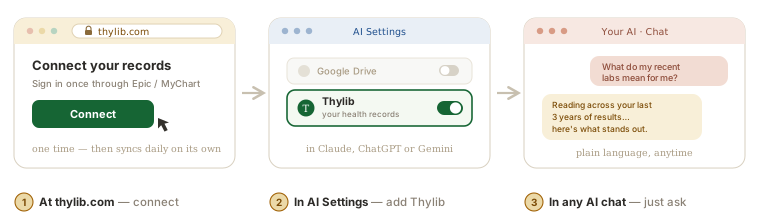
Setup takes about two minutes. You connect your records once at thylib.com, turn on the Thylib connector in your AI's settings, and from then on you just ask — in plain language, whenever a health question comes up. Your records keep syncing on their own, so the picture stays current with no upkeep.

Three steps to use Thylib: at thylib.com, connect your records by signing in through Epic or MyChart; in your AI's settings under Connectors, turn on the Thylib connector in Claude, ChatGPT, or Gemini; then in any AI chat, ask a question in plain language.
What's MCP?
Open standard

The Model Context Protocol is the open standard AI assistants use to connect to outside data. Claude calls these connectors; ChatGPT calls them apps. Thylib is a connector for your own health data — your records stay under your control, and your AI of choice queries them when you ask a question.

Same plumbing Anthropic uses for Google Drive, Gmail, and 200+ other connectors. Nothing Thylib-specific to install on the AI side.

Community

You don't have to figure it out alone.

Thylib is founder-run — every email is read by me — and r/thylib is where it happens in the open. Ask questions, see how other people put their records to work, and tell me what to build next.

Ask anything

Setup, a confusing result, whether your hospital is supported — real answers, often straight from the founder.

See it in use

How other people work with their records in Claude, ChatGPT, and Gemini — the prompts and habits that actually help.

Say what's missing

Tell us what's broken or absent. A record that looks wrong is the most useful thing you can send.

Join the community reddit.com/r/thylib

Ready to understand your health?

Start with the demo, then connect your own records free for 90 days — no card, no auto-charge. Delete anytime.