For health that's too complicated for one visit

Your whole chart,
finally read.
Know thyself with AI.

More than one doctor, more than one hospital, years of results — and every visit looks at one slice. Thylib syncs the whole record, for you and the people you care for, so the AI you already use can read all of it: every lab, every visit, every prescription, each with a link to the source.

The library, the conversation, and the literature, together. That's where clarity comes from.

Try the demo Get started

Live demo with realistic sample records — no account, no card.

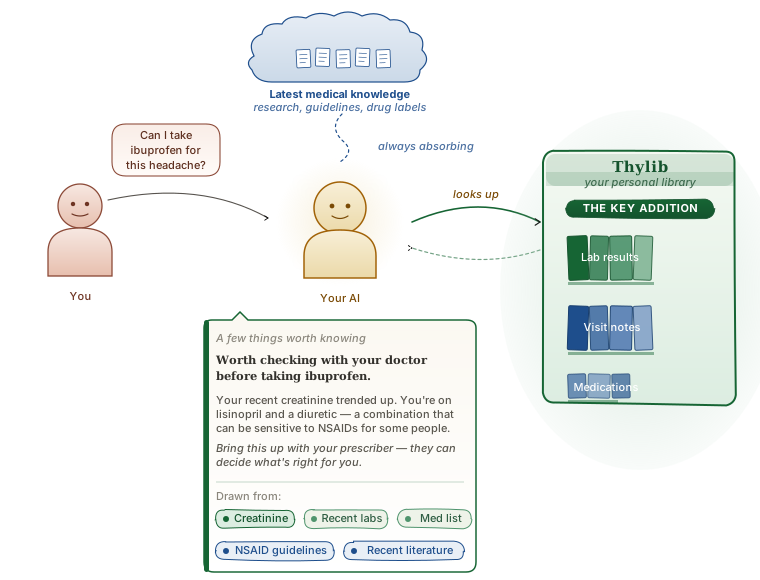
Diagram showing how Thylib connects your medical records, labs, and lived experience to the AI you trust, alongside the latest medical knowledge.
Who it's for

Your health is complicated enough.
Your record shouldn't be.

Some conditions are complicated in themselves — several specialists, treatments that change, years of results that only make sense together, and long stretches where nothing has worked cleanly. For the people living with that, and the people who look after them, Thylib is the library: the whole record in one place — every hospital, every year — so it can be read end to end instead of a slice at a time.

You have more than one diagnosis, and they interact.

Each specialist treats their own part, across portals that don't talk. The overlap is yours to carry.

Nothing has worked cleanly yet.

Medications started, stopped, doses changed. What has been tried — and what it did — is rarely written down in one place.

You're handed reports written for someone else.

A pathology report, an imaging read, a letter back to your PCP: written for the clinician who ordered it, and read by you.

There's a decision coming, and the trade-offs are real.

Operate or wait. Switch or stay the course. Fifteen minutes to ask, and years of history that should inform it.

You're holding someone else's chart.

A parent's medication list, a child's history. Add them through the MyChart proxy access you already have, and ask on their behalf.

Thylib doesn't decide any of this for you. It puts the whole record where the AI you already use can read it with you — so you can see what your own file actually says, keep track of what has already been tried, and arrive with better questions for the people who treat you.

See the difference

The same AI. A very different answer.

Generic answers come from generic context. When your AI can read your full medical history — every lab, visit, and prescription — it can actually answer the question you're asking.

Your daughter sees her pediatrician at one hospital and an asthma specialist at another. You've had a feeling about her heart rate for a couple of years.

you ask Claude
“Give me every heart-rate reading in her chart, with dates.”
Without Thylib

I can't see medical records. Generally, a resting heart rate for a child this age runs higher than an adult's — roughly 80 to 120 beats per minute. If you've noticed something that worries you, it's worth raising with her pediatrician, who can check it properly.

With Thylib

28 readings, 2021 to 2026, across both clinics:

2026-08-12   138   above range     asthma specialist
2026-04-15   129   above range     asthma specialist
2026-03-14    73   no range filed  pediatrician
2026-03-07   100   no range filed  pediatrician
2026-01-21   134   above range     asthma specialist
2025-09-20    97   no range filed  pediatrician
2025-09-17   112   within range    asthma specialist
2025-05-31    81   no range filed  pediatrician
2025-05-28   136   above range     asthma specialist
2025-05-24    85   no range filed  pediatrician
2025-05-17   100   no range filed  pediatrician
2025-03-22    81   no range filed  pediatrician
2025-02-19   128   above range     asthma specialist
2024-11-06   131   above range     asthma specialist
       …     14 more, 2021–2024, all pediatrician, 67–94

Six of the seven readings from the specialist are above the reference range filed alongside them — 80 to 120 per minute, for her age. Her pediatrician's 21 readings run 67 to 100 and carry no reference range at all, so nothing in that chart was ever marked either way. Neither clinic can see the other's records.

I can't tell you why, and the explanation may be ordinary: the specialist visits are the ones where she was seen for breathing symptoms, and her rescue inhaler is a known cause of a faster heart rate. What I can say is that it's a pattern across six visits, in the half of her record her pediatrician never sees — worth taking to her doctor as a list rather than a feeling.

Hospital A · Hospital B · synced today · view record

Two more examples, and how it works →

The literature

Your record has the facts.
Your AI knows the medicine.

Look back at the answer above. The 28 heart-rate readings came from her record. “Her rescue inhaler is a known cause of a faster heart rate” did not — no chart says that. It came from the AI, which knows the medicine most of us were never taught. Thylib is the library; this is the literature. Either one alone gives you a list of numbers, or a textbook about somebody else.

What a test measures.

And why it was likely ordered — for a result you have never heard of.

Why two prescriptions carry a warning together.

The kind printed on the label: an NSAID for someone whose kidneys are already strained.

What a report written for another clinician says.

An imaging read, a pathology line, a letter back to your PCP — in plain language.

What guidelines and research say.

About a condition that is actually in your record, not one in a general article.
Limits & accuracy

Knowledge is where AI is strongest. Deciding what it means for you is a conversation for your doctor — AI can be wrong, and health is where that matters most.

Where it can be wrong.

Judgment about you. “This suggests X” is reasoning, and reasoning misses things. Records are incomplete too: a hospital only knows what it saw, and today’s lab may not have synced yet.

What keeps it honest.

Every number comes from a query against your synced chart, not the model’s memory. Every claim links to its source record, every answer carries a freshness stamp, and access is read-only — it can never change a record.

What it can and can't do, in full → Spot something wrong? Tell us — every report becomes a test case.

Beta

Beta means: the software is thoroughly tested — what varies is the data. Every hospital system fills in its records a little differently, and we've worked with only a handful of systems so far. Until we've read many more, we call it beta. While we're in beta the free trial period is 90 days instead of 14.

Your data

Where your record goes. And where it doesn't.

Nobody in between.

Straight from your hospital’s patient-access API into your library — no aggregator, no broker.

Never sold, never mined.

You pay us; nobody else pays for access to you. No ads, no research licensing.

The AI is yours.

Records go only to the assistant you connect, only when you ask — and we never train on them.

Delete means destroyed.

One click, permanently destroyed within 14 days.

Where your record goes, in full → Encryption, family consent and access logs, and the exact setting that keeps each AI from training on your conversations.

Pricing

One plan. Everything included.

90-day free trial while we're in beta — no card, nothing charged when it ends. Then $39.99 / year for up to 4 people.

After beta, the trial is 14 days; anyone who starts during beta keeps their 90.

Thylib — household
$39.99/ YEAR
Covers up to 4 people in your family.

About what one rushed appointment costs — for a full year of everyone's history, always within reach.

90-day free trial on your own records — no card, and nothing is charged automatically when it ends.

Get started
What's included
  • Every provider you connect
  • Synced automatically, every day
  • All tools, unlimited questions
  • Works with Claude, ChatGPT & Gemini
  • Up to 4 family members
  • Delete everything, anytime

Ready to understand your health?

Start with the demo, then connect your own records free for 90 days — no card, no auto-charge. Delete anytime.